

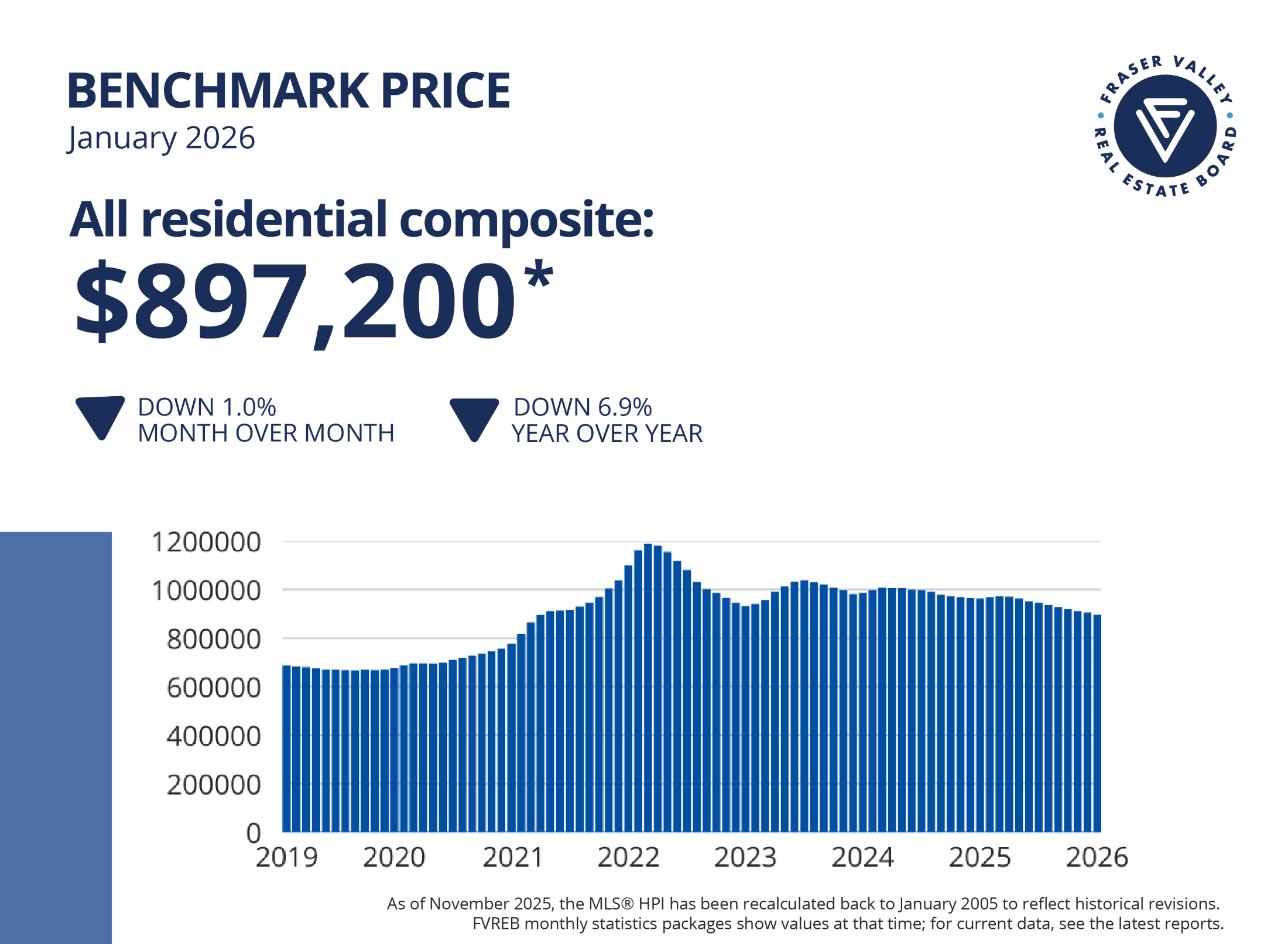
Home prices across the Fraser Valley declined for the tenth consecutive month in January, with the all-residential Benchmark price falling to $897,200, as shown in the Benchmark Price image. This represents a 1.0 per cent month-over-month decrease and a 6.9 per cent year-over-year decline, marking the first time since spring 2021 that the composite benchmark has dipped below $900,000.
Sales Slow Despite Improved Affordability
As illustrated in the MLS® Sales image, the Fraser Valley Real Estate Board recorded 619 sales in January, down 32.6 per cent from December and 24.3 per cent below January 2025 levels. While new listings rose seasonally to 3,078 — up 128 per cent from December — activity remained 10 per cent below last year’s pace.
Overall inventory climbed to 7,711 active listings, sitting 11 per cent above December and 54 per cent above the 10-year seasonal average. With a sales-to-active listings ratio of eight per cent, as reflected in the market snapshot, the Fraser Valley remains firmly in buyer’s market territory (a balanced market typically ranges between 12 and 20 per cent).
“January opened the year with negligible momentum,” said Tore Jacobsen, Chair of the Fraser Valley Real Estate Board. “Prices continued to weaken while at the same time selection remains high. Under normal market dynamics, these would be considered highly favourable conditions for buyers; however, the uncertainty of the past year continues to loom large, subduing buyer confidence and muting overall market activity.”

Price Breakdown by Property Type
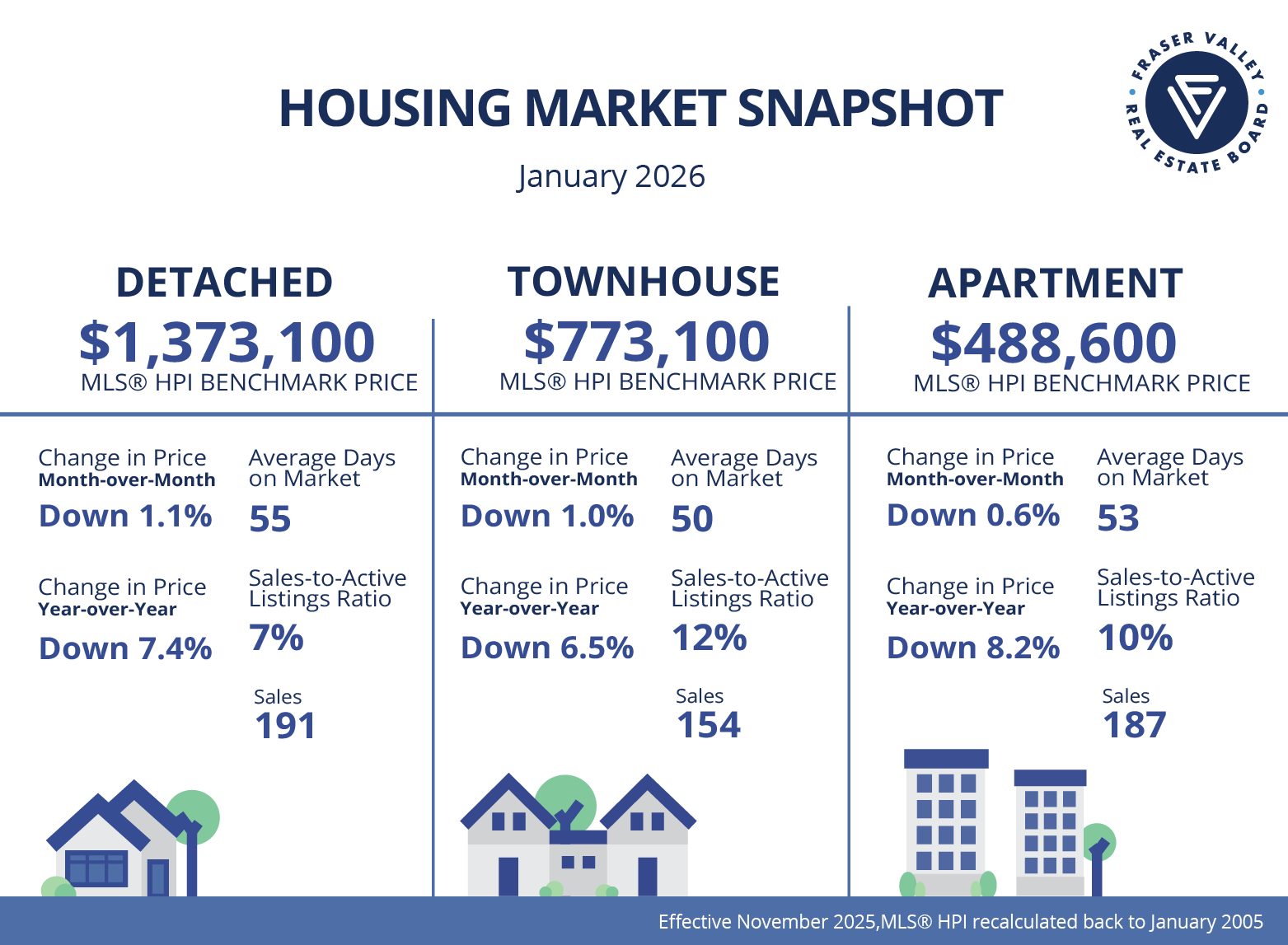
The Housing Market Snapshot image highlights continued softening across all property categories:
Detached Homes: Benchmark price of $1,373,100, down 1.1 per cent month-over-month and 7.4 per cent year-over-year. Average days on market: 55.
Townhomes: Benchmark price of $773,100, down 1.0 per cent month-over-month and 6.5 per cent year-over-year. Average days on market: 50.
Apartments/Condos: Benchmark price of $488,600, down 0.6 per cent month-over-month and 8.2 per cent year-over-year. Average days on market: 53.
Sales-to-active listings ratios remain in buyer’s market range across all segments, with detached homes at seven per cent, townhomes at 12 per cent, and apartments at 10 per cent.

Broader Affordability Pressures Persist
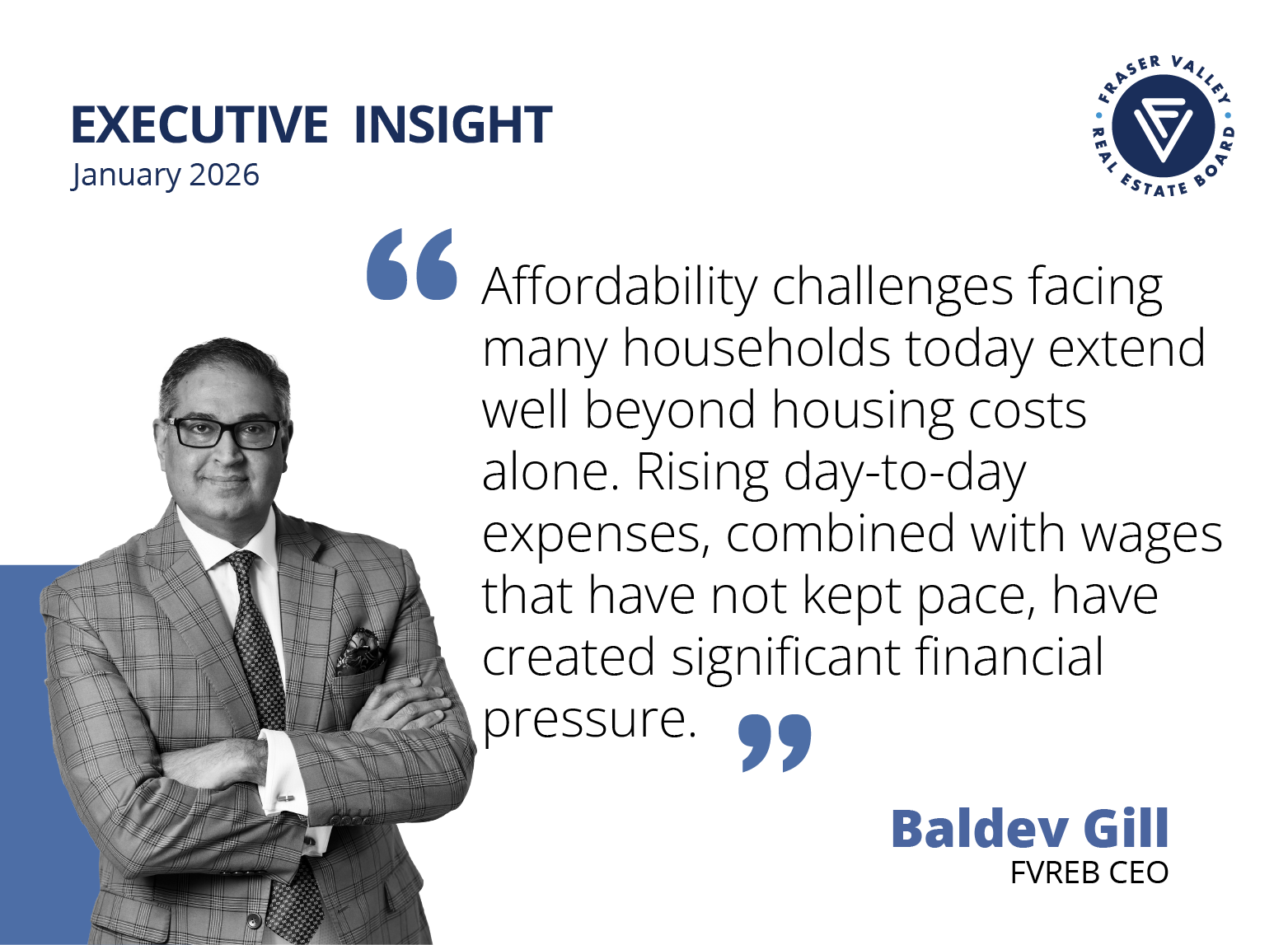
In the Executive Insight image, Baldev Gill, CEO of the Fraser Valley Real Estate Board, notes that affordability challenges extend beyond housing prices alone.
“Rising day-to-day expenses, combined with wages that have not kept pace, have created significant financial pressure. As a result, potential buyers are choosing to be more circumspect and are working with REALTORS® to develop timing strategies that meet their long-term objectives.”
Market Outlook
The data and visuals collectively point to a market characterized by elevated inventory, declining prices, and restrained buyer participation. While pricing conditions may appear favourable compared to peak years, confidence remains the missing ingredient needed to restore momentum.
As the Fraser Valley moves further into 2026, attention will remain focused on economic stability, borrowing conditions, and whether sustained pricing adjustments are sufficient to re-engage sidelined buyers.
 The data relating to real estate on this website comes in part from the MLS® Reciprocity program of either the Greater Vancouver REALTORS® (GVR), the Fraser Valley Real Estate Board (FVREB) or the Chilliwack and District Real Estate Board (CADREB). Real estate listings held by participating real estate firms are marked with the MLS® logo and detailed information about the listing includes the name of the listing agent. This representation is based in whole or part on data generated by either the GVR, the FVREB or the CADREB which assumes no responsibility for its accuracy. The materials contained on this page may not be reproduced without the express written consent of either the GVR, the FVREB or the CADREB.