

NOVEMBER UPDATE | OCTOBER 2026 STATISTICS
Sales improve, but buyers still have the advantage
Elevation Real Estate Group | RE/MAX Treeland Realty | November 4, 2026
October brought a welcome improvement in Fraser Valley home sales and a slower pace of price declines. Buyers still have considerable choice, however, and the market has not established a broad recovery. The latest FVREB statistics, released November 3, show a seasonal improvement in activity alongside lower inventory.
Our outlook is for continued negotiating room and uneven price pressure through winter. Langley townhouses stand out, but local detached homes and apartments did not share the regional sales rebound. With the Bank of Canada raising rates in late October, financing costs deserve renewed attention.
More sales and fewer listings, with a seasonal caution
FVREB recorded 1,051 sales in October, up 14.0% from September but down 6.4% from October 2025. New listings fell 9.5% for the month to 2,551, also 14.0% below a year earlier. Active listings declined to 9,164, down 6.1% monthly and 9.5% annually.
That combination improved the sales-to-active listings ratio to 11.5%, calculated from reported sales and month-end inventory, compared with 9.4% in September. It remains below the usual balanced range of 12% to 20%. The direction is encouraging, but the improvement fits a seasonal pattern, and sales remain below last October.
Year-to-date sales total 9,765, down 5.8%. New listings are down 12.9% to 29,949. Supply is retreating faster than sales over the year, which may gradually ease the imbalance. It has not yet produced sustained price stability. Average selling times were 50 days for detached homes, 37 for townhouses and 44 for apartments.
Price declines slowed, but have not stopped
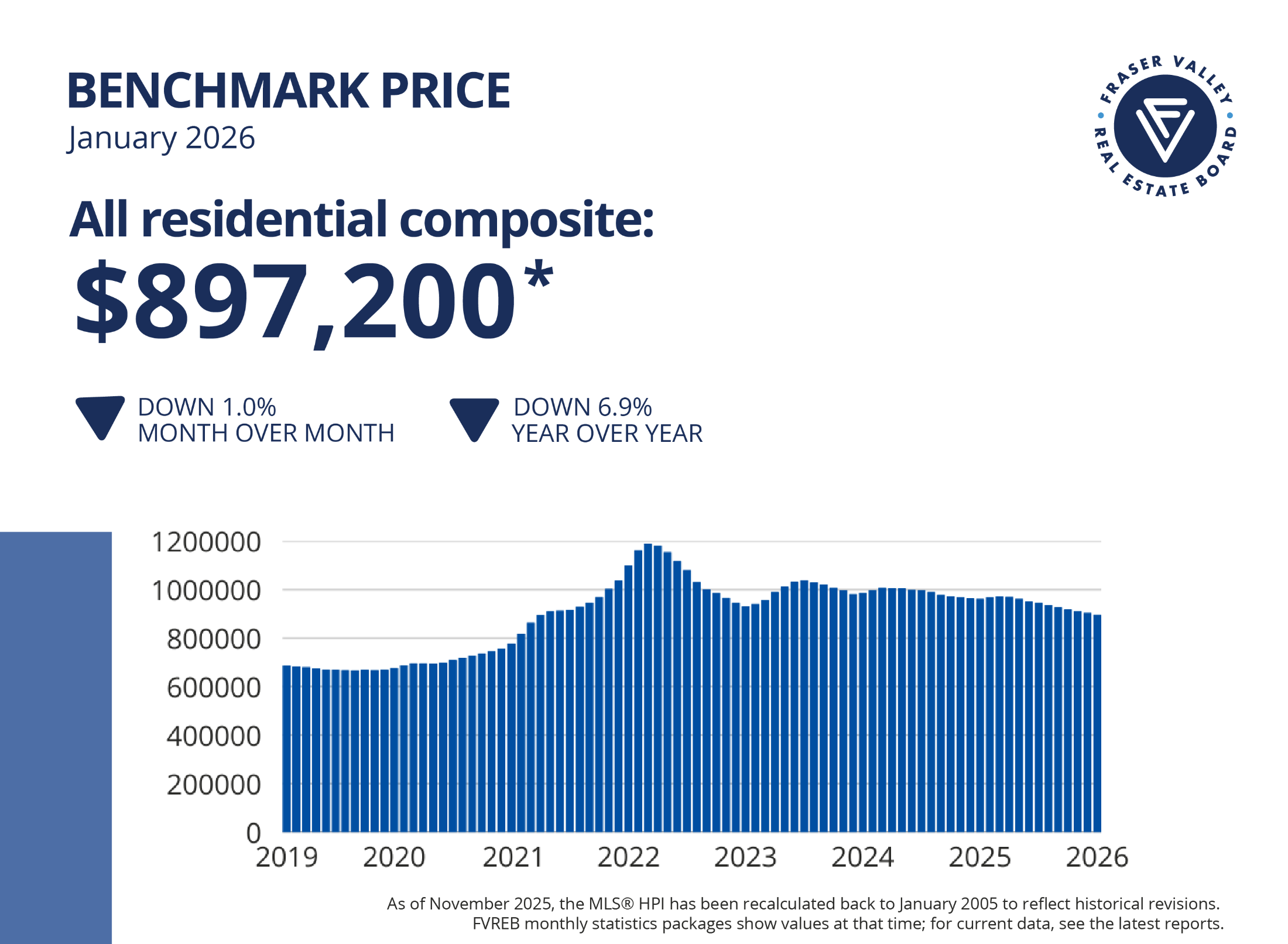
The composite benchmark reached $860,000, with FVREB reporting a 0.1% monthly decline and a 6.4% annual decline. Each major property type also fell, although by less than in September.
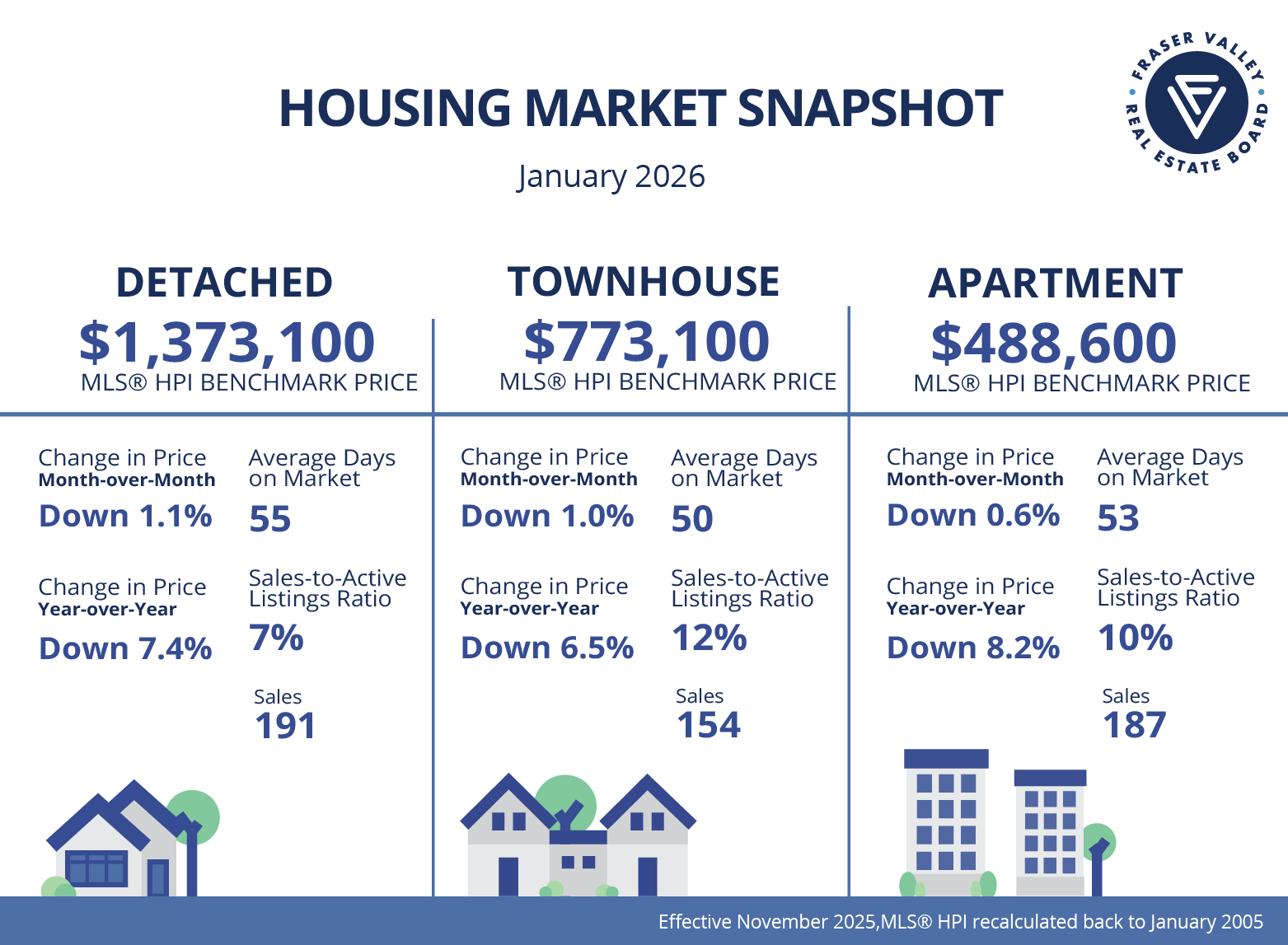
| Property type | Benchmark | 1 month | 3 months | 1 year |
|---|---|---|---|---|
| Detached | $1,293,800 | -0.5% | -3.1% | -8.5% |
| Townhouse | $742,300 | -0.4% | -2.0% | -5.5% |
| Apartment | $460,800 | -0.2% | -1.8% | -8.1% |
Detached homes still show the largest three-month decline. Townhouses have held up better annually, but none of the regional categories have turned positive. One gentler month is a reason to watch closely, not enough to call a bottom.
A benchmark follows a home with typical characteristics. It is different from an average sale price, which changes with the mix of homes sold. The regional average fell 1.9% in October, but that does not mean every property's value fell by that amount. Pricing decisions still need recent comparable sales and current competing listings.
Langley: townhouse strength, with softer detached demand
Comparing the same property types makes the local differences clearer. Regional sales-to-active ratios were 12.8% for detached homes, 17.2% for townhouses and 11.6% for apartments.
| Langley | Sales | Active | Ratio | Benchmark | 1 month |
|---|---|---|---|---|---|
| Detached | 59 | 434 | 13.6% | $1,448,100 | -1.6% |
| Townhouse | 76 | 260 | 29.2% | $800,600 | -0.2% |
| Apartment | 60 | 404 | 14.9% | $522,300 | -0.7% |
Townhouses: Sales rose 24.6% monthly and 7.0% annually, while inventory fell 8.1% for the month. The 29.2% ratio reflects both more sales and fewer available listings. It is above the usual balanced range, yet the benchmark still edged down and remains 3.7% below last year. Sellers have a stronger relative position here, but that does not justify assuming every townhouse will attract multiple offers.
Detached homes: Sales fell 7.8% from September and 25.3% annually. The benchmark declined 1.6% in October, compared with 0.5% regionally, and is down 3.5% over three months. Regional detached sales rose, so that headline should not be applied automatically to Langley. Local buyers remain selective.
Apartments: Sales declined 10.4% monthly and 20.0% annually. Inventory is 27.2% below last October, helping the ratio remain within the usual balanced range. Nevertheless, the benchmark fell 0.7% monthly and 8.4% annually. Lower inventory alone has not stopped prices from adjusting.
Rates and employment add reasons for caution
The Bank of Canada raised its policy rate by 0.25 percentage points to 2.50% on October 28. It cited more persistent inflation pressures and said further increases could be needed. Its next scheduled decision is December 9. Most October transactions preceded this decision, so the month's sales figures cannot show its full effect.
We would revisit financing with a mortgage professional before making a commitment. Variable borrowing costs are sensitive to policy-rate changes; fixed rates are also influenced by bond yields and lender pricing. A lower purchase price does not necessarily mean a lower monthly payment.
Statistics Canada's September Labour Force Survey, released October 9, reported 68,000 fewer jobs nationally and unemployment at 6.5%. BC employment fell by 20,000. These broader figures support caution about household confidence, but are not a direct measure of employment in Langley. They are September figures, not an October employment result.
BCREA's October 14 release also reported weaker September activity provincially: sales were down 8.9% annually and 25.8% below the ten-year average for that month. It noted that declining inventory was helping market balance. That is useful provincial context, while October's FVREB figures provide the more recent local picture.
What we expect through winter
Our base case is a gradual, uneven adjustment rather than a rapid rebound. October offers more evidence of improving supply and demand than September did, but higher borrowing costs and weak annual sales limit how far we would take that signal. These are our expectations, not guaranteed outcomes or numerical price forecasts.
November: We expect listing activity to ease seasonally. The important test is whether sales hold up as buyers reassess financing after the rate increase. If inventory falls mainly because owners withdraw, a better market ratio would tell us less about demand than continued sales growth would.
December: Holiday activity and smaller transaction counts can make monthly changes less reliable. We expect motivated buyers and sellers to keep negotiating, with sharper differences between well-priced homes and stale listings. The December 9 rate decision may influence confidence, but we would not plan around a particular outcome.
Early 2027: A sustained improvement would require demand to keep pace when more listings return. We will watch whether benchmark prices flatten for several months, sales improve beyond normal seasonal patterns and inventory continues to shrink relative to demand. Continued rate pressure or weaker employment would increase the risk of further softness.
How to approach this market
Buying: Use the available choice to compare homes, confirm financing and complete inspections and document review. Negotiate price, dates and appropriate conditions. Langley townhouses may offer less room than the broader market, so base each offer on the property's actual competition.
Selling: Price against what buyers can purchase today. Presentation matters, but it cannot fully offset an asking price above current value. Review qualified offers and feedback promptly. A slower pace of benchmark declines is encouraging, but waiting for spring still involves carrying costs and market risk.
Buying and selling: Focus on the complete move: the price difference, financing, transaction costs and timing. Selling a townhouse to buy detached could involve two quite different negotiating positions. We can compare both sides before you decide which step to take first.
If you are considering a move in Langley or elsewhere in the Fraser Valley, contact our team for a closer look at recent sales and competing listings relevant to your plans.
Source: Fraser Valley Real Estate Board, October 2026 statistics package, released November 3, 2026, PDF pages 2-4 and 6. Price changes follow the detailed HPI table. Monthly sales and listing figures are not seasonally adjusted. Regional totals include all property types; category comparisons cover detached homes, townhouses and apartments. Ratios are monthly sales divided by month-end active listings, rounded to one decimal. FVREB rounds the overall ratio to 11% in its release. A single month's ratio does not establish a price trend, and benchmarks are not valuations of individual properties. Economic context checked November 4, 2026. Read the full FVREB report.









 The data relating to real estate on this website comes in part from the MLS® Reciprocity program of either the Greater Vancouver REALTORS® (GVR), the Fraser Valley Real Estate Board (FVREB) or the Chilliwack and District Real Estate Board (CADREB). Real estate listings held by participating real estate firms are marked with the MLS® logo and detailed information about the listing includes the name of the listing agent. This representation is based in whole or part on data generated by either the GVR, the FVREB or the CADREB which assumes no responsibility for its accuracy. The materials contained on this page may not be reproduced without the express written consent of either the GVR, the FVREB or the CADREB.